

Isamu Noguchi, the son of a Japanese father and an American mother, spent his childhood in Japan and worked as a sculptor mainly in the United States and France during his 20s. Noguchi, who studied sculpture under the sculptor Constantin Brancusi, is known as one of the leading sculptors of the 20th century for his rich sensitivity and scale of expression, including numerous sculptures that utilize materials such as stone, metal, and wood, as well as landscape designs for parks and gardens, which can be considered sculptures of the earth. He is known as one of the leading sculptors of the 20th century.

Photo credit: https://www.economist.com
"When you are facing a natural stone, it starts to talk to you. When I hear their voices, I give them a little help."
As his famous phrase expresses, Noguchi's sculptures, based on simple forms such as straight lines and circles, draw out the individuality of the materials as they are, and give us a sense of fundamental strength, as if he were speaking of the providence of nature and the universe.
Noguchi is also known to have struggled with questions of identity related to his nationality. Having experienced the profound pain of his parents’ homelands becoming enemy nations during the war, he created many works imbued with a strong wish for peace.
The Inner Stone (1973)
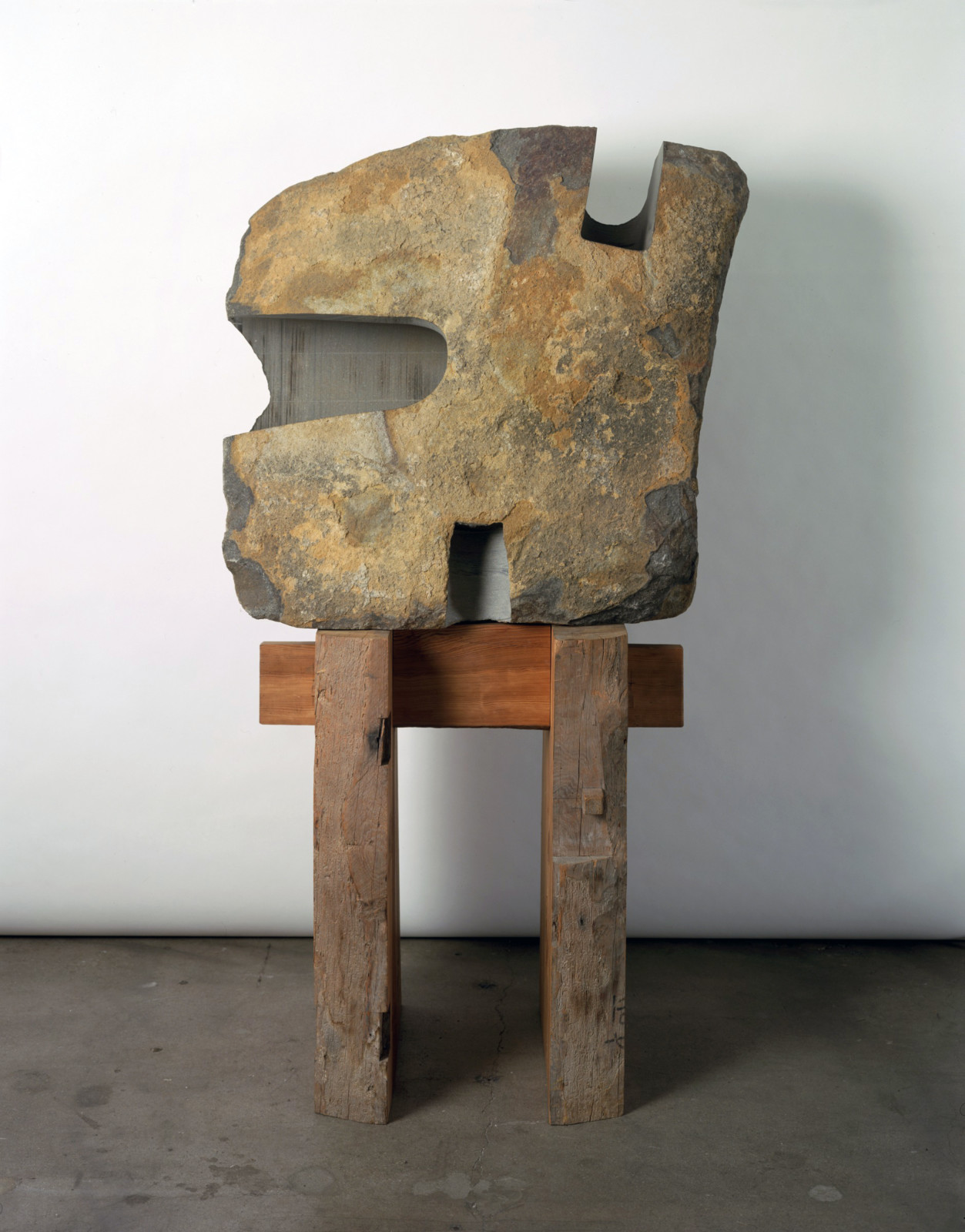
Photo credit: https://www.noguchi.org
Energy Void (1971)
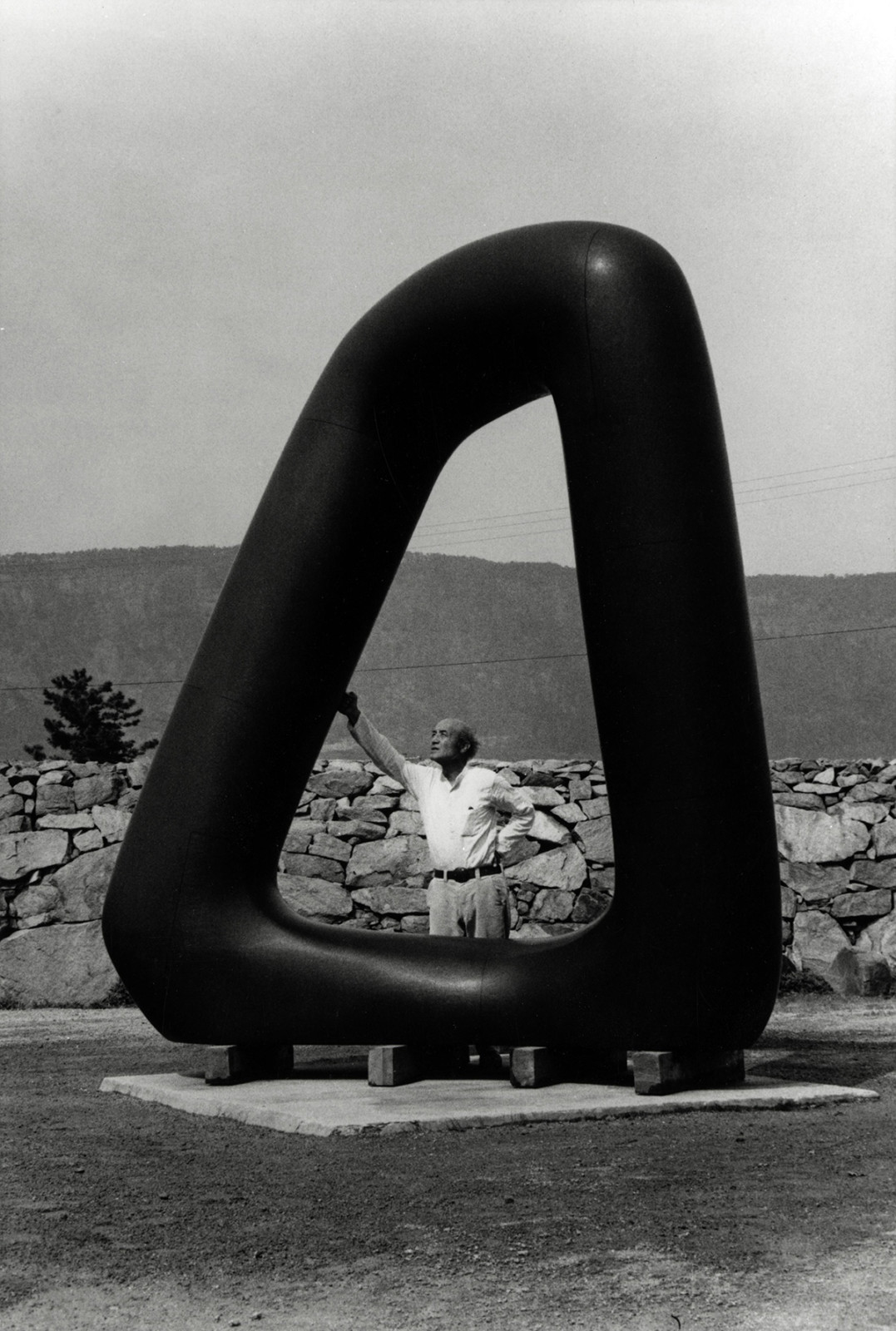 Photo credit: https://www.noguchi.org
Black Slide Mantra (late 1960s - late 1980s)
![The Isamu Noguchi Archive : Transparency : Black Slide Mantra [00604]](https://archive.noguchi.org/media/nogarchive/images/4/6/1/94610_ca_object_representations_media_46185_page.jpg)
Photo credit: https://www.noguchi.org
“AKARI,” the sculpture of light

As one of the most influential sculptors of the 20th century, Isamu Noguchi continues to inspire and move people around the world. While devoting much of his life to sculpting in stone and working with the earth, he also pursued a lifelong project over 35 years: the light sculptures known as “AKARI.”
“AKARI” is a series of sculptural works based on traditional Gifu lanterns. Using simple materials such as washi paper and bamboo ribs, Noguchi refined elements like stands and fittings, creating pieces that can even be folded compactly for storage.
More than 200 designs were created, evolving into various series—from the D Series (with irregularly wrapped bamboo ribs), to the N Series (featuring forms inspired by objects like kagami mochi and eggplants), and the P Series (which forgoes bamboo ribs to highlight the natural creases of folded washi). Each reflects an expansion of traditional lantern-making techniques.
AKARI embodies both function and art: a lighting object for everyday interiors, designed to be accessible and reproducible, bringing light into people’s lives.
The name “AKARI” refers to natural light—like that of the sun or moon—captured and brought into a room. Its soft glow diffuses gently throughout the space, enveloping daily life in warmth.

“I named my work ‘AKARI,’ rather than calling it a lantern.
The word akari comes from the idea of bringing the light of the sun and moon into a room—the kanji itself is composed of the characters for sun and moon.In modern life, lighting that resembles natural light is something we long for. Light passing through washi paper diffuses gently, spreading a soft glow throughout the entire space. ‘AKARI’ is a sculpture of light itself—a sculptural work without shadow.”

Light for Everyday Life — Ubiquitous Sun
Just as the sun and moon illuminate the earth—so too does “AKARI” light a space.
OAO’s SUNLIGHT was born from an understanding of Noguchi’s life and character, and from exploring the origins of “AKARI.” The multiple stitch lines on the upper are inspired by the organic bamboo rib structures of “AKARI,” designed to echo Noguchi’s gentle, childlike curiosity and sense of play.
Through something we wear every day—shoes—we hope to softly illuminate daily life from the ground up, bringing a quiet brightness to each moment.
Light at your feet, for everyone.
